 secretGeek.net
The Yerkes-whatzy law of who now?
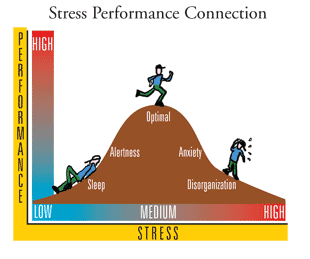
In psychology they have something called 'The Yerkes-Dodson Law of Arousal' which goes roughly like this:
"Performance increases with arousal but only to a certain point: when levels of arousal become too high, performance will decrease."
'Arousal' doesn't mean sexual arousal, you dirty-minded buffoons, so stop sniggering. 'Arousal' means 'Cognitive Arousal' and could also be taken to mean 'alertness', or 'pressure'. A common synonym is 'stress'.
The YD-Law is demonstrated in the graph shown on the right.
Let's break the graph into three regions:
- When your stress is low, you won't perform well.
- With just the right amount of pressure you'll achieve your peak performance. This is sometimes referred to as being "In The Zone."
- With too much stress your performance will degrade.
We can term these three regions as "Low Stress", "Optimal Stress" (aka 'The Zone'), and "Over Stressed".
(Continues)
Now what can we surmise?
When you're in the "Low Stress" region, you need more stress to improve your performance. Telling yourself to relax will not improve your performance.
When you're in the "Over Stressed" region, you need less stress to improve your performance. Getting mad at yourself will not help. A manager emphasizing the deadlines will not help. A manager jumping up and down and screaming at you will not help.
If you've been slowly ramping up the stress on your employees, you may, just possibly have found some improved performance. This doesn't mean that further increases in stress will continue to cause improvements in performance. Instead you may find your employees beginning to turn into walking zombies.
And if you're suffering from procrastination -- take a moment to decide whether you're under-stressed or over-stressed.
For the over-stressed:
Go easy on yourself.
Don't try to push yourself harder. Your performance will only decrease.
Chill out a little, take a few long slow calm breaths.
Close your eyes and take a few more slow deep breaths.
Think relaxing thoughts.
For the under-stressed:
Don't try to chill out: Try to perk yourself up instead.
Go for a run, or a brisk walk, whack a shot of coffee down your throat.
Get active. Extra deep breaths, not so slow, not so calm.
But It Could Also Be...
One other point though: if you're exhausted, hungry, thirsty, intoxicated, or just busting to pee, then the YD-law isn't what's limiting your performance: deal with your bodily needs, dude. Sleep, Eat, Drink, Dry out, Pee: don't put it off any longer, your performance will only get worse.
Now: Let's Go 3D
Getting back to the YD-law, consider a range of tasks with different cognitive requirements: a game of sudoku, a fight to the death, a bout of furious making love, and a quick game of darts. (Your standard morning).
All of these tasks will have different optimal stress levels.
For simple tasks, a higher amount of stress will result in optimal performance.
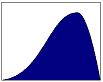 For example, imagine you are performing in a short sprint. What sort of arousal will lead to your best performance? The YD-Law predicts that a simple task like sprinting is best achieved at a very high level of physical arousal (see the image at right). For example, having your track team pursued by a blood-thirsty man-eating lion would be a good way to encourage maximum performance. Soothing music would not help.
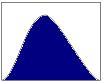 Another task, such as playing a game of Tennis, might combine mental flexibility with physical strength, and peak at a slightly lower stress-level. It's very possible to get psyched out, but it's also possible to be under-enthused. The blood-thirsty lion would be likely to put you off your game (you'd get "psyched out"). Soothing music might also be too calming. But an enthusiastic and energetic crowd will probably help spur you to your optimum level of stress.
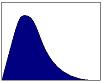 Consider a purely logical task, such as solving a Sudoku square: too much stress will quickly cause decreased performance, and the peak is reached at a very low level of stress. The blood thirsty lion will definitely not spur you onto a faster performance. And the cheering crowd will probably put you off. In fact, just one person looking over your shoulder might be too much pressure. The soothing music is probably useful, provided you don't go to sleep.
Yerkes-Dodson in the Work Place
Now let's apply this new piece of information to the office setting.
A "high pressure" sales team, for example, will peak at a different level of excitement to a busy team of computer programmers. So if your open-plan office puts thinky-programmer types side by side with a talkative and intense sales team, the programmers will get over-stimulated, over-stressed and anxious.
Ditto for putting the marketing team next to the accounts payable team.
Forget Feng-Shui for the office -- this is "Yerkes-Dodson for the office". A far more valuable concept. (Note to self: write book on this and tour the globe giving expensive talks)
In our society i think we have more problems with the "right hand side" of the YD graph (over-stress) than we do with the left hand side.
This 'Right-hand' lifestyle is characterized by a sense of "desperate-Urgency" and ongoing exhaustion, through which you push yourself to achieve more.
When in this "urgent" frame of mind you never realise for a moment that slowing down, pushing yourself a little less, will actually increase your productivity. You're in a frame of mind that thinks the only solution is to push harder! Faster! Do More! Get More Things Done!
In our society we've removed real physical dangers from our environment. There is no lion hiding behind the water cooler, about to leap out at you. The threats we face are not physical. They're threats to our ego, our self-esteem, our work hours, our take home pay. Less physical, more abstract, more long-term. Such dangers are best faced with a cool head. Getting steamed up won't push you into achieving a better response -- it will push you past the optimum Zone.
So, think Yerkes-Dodson.
Chill out when you're stressed out. Stress up when you're too chilled.
Be good to each other. Pay for that free software you're using. Wear sunscreen. Go easy on your bus driver -- those guys have the most stressful job of all, forgive them their cranky temperament, just be glad that you don't drive the bus.
And don't hit people on the head when they're trying to learn asp.net. It won't help.
(The excellent illustration above is courtesy of The Manitoba Farm & Rural Stress Line)
Next → ← PreviousMy book "Choose Your First Product" is available now.
It gives you 4 easy steps to find and validate a humble product idea.